
Parkinson’s Law: Why tasks grow when time expands
I have always been fascinated by the invisible forces that shape how we work. Not the loud ones, like motivation or ambition. The quiet ones, like constraints, friction and the shape of the container around a task.
One pattern keeps showing up.
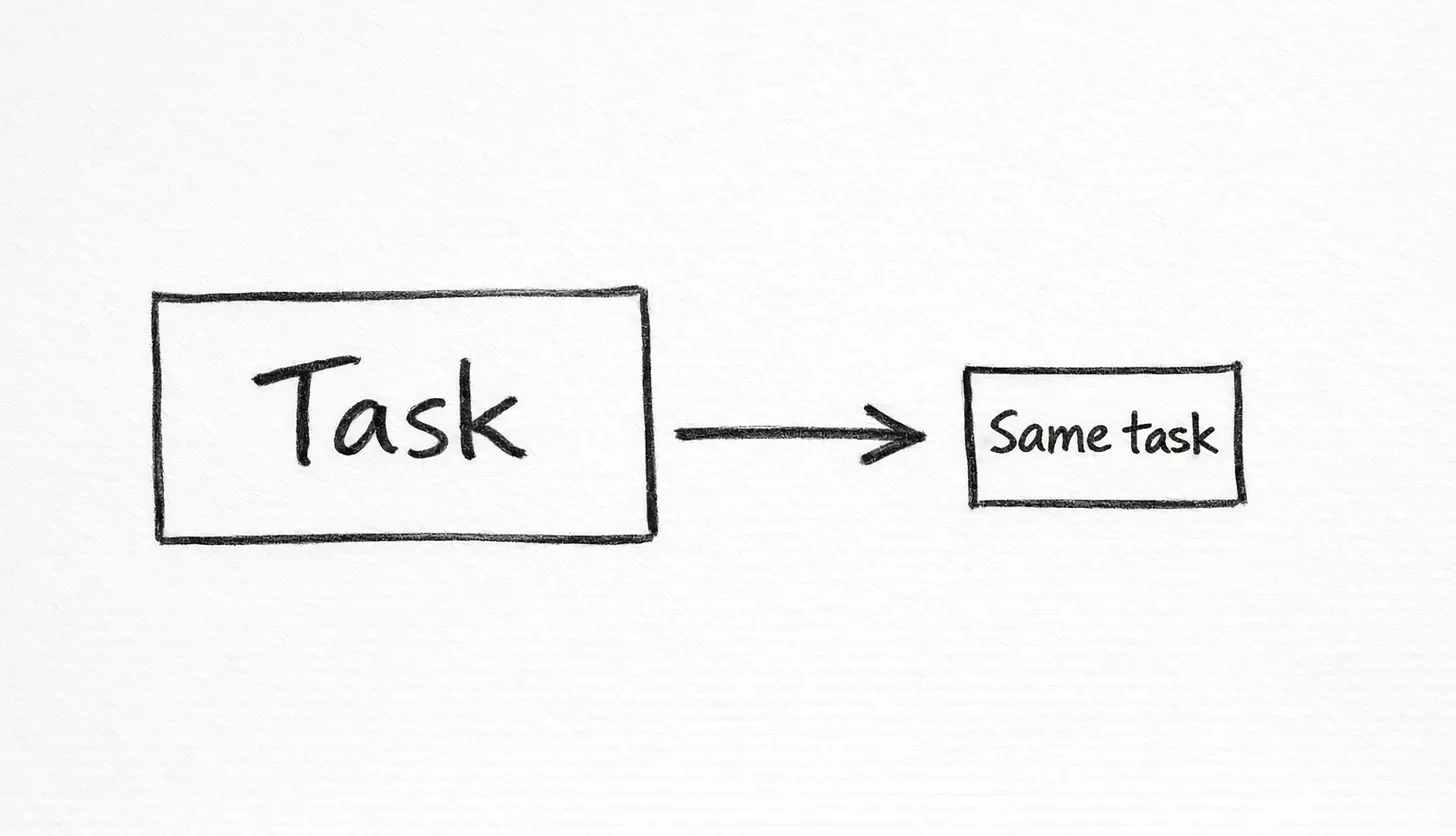
Give a task a week and it becomes a week long task.
Give the same task an afternoon and it somehow fits inside that smaller space.
The quality often stays the same. The time and effort do not.
That pattern pulled me back to a concept I first encountered years ago, Parkinson’s Law.
A simple line, almost too simple.
Work expands to fill the time available for its completion.
Once I started watching my own behavior through that lens, it became hard to unsee.
This text is about how Parkinson’s Law actually works, what research supports and why constraints might matter more for human behavior than most of us want to admit.
Let’s dive in.
The mechanism
Parkinson’s Law is named after C. Northcote Parkinson, who wrote a satirical essay in The Economist in 1955. He observed two things:
Bureaucracies tend to grow regardless of workload.
Work expands to fill the time available for its completion.
It was satire. But the mechanism is real.
At a personal level, Parkinson’s Law is not about laziness. It is about drift.
When a task has loose boundaries, your brain fills the space with:
Additional refinement.
More research than necessary.
Extra steps that feel responsible.
Micro decisions that inflate effort.
Overthinking disguised as quality.
The task rarely becomes better in proportion to the time added. It usually becomes bigger.
What looks like a time problem is often a boundary problem. The brain defaults to expansion unless a constraint directs it.
To make the idea concrete, Parkinson’s Law means:
Tasks grow to match the size of their time container
More time increases drift and unnecessary refinement
Tighter boundaries increase focus and cleaner decisions
The task is shaped more by its constraints than its complexity
What the research supports
Parkinson did not write a scientific law. But the dynamics behind it show up in a few well established areas.
Deadlines shape behavior
Psychology and project‑delivery research shows a pattern that most people recognize:
Long deadlines increase delay, drift and overthinking
Shorter deadlines increase focus, decisiveness and execution
Tasks rarely finish early but almost always finish exactly when the window closes. Boundaries change the behavior inside the boundary.
Systems create work to justify themselves
In organizations, researchers have repeatedly observed a related dynamic. Internal work tends to grow even when true workload does not.
Coordination creates more coordination.
Processes create more process.
Work expands to fill available capacity even when the actual need does not.
This is the organizational cousin of the personal version.
What the science actually supports
Bureaucracies grow even when workload does not.
Groups become less efficient as they get larger.
Tasks stretch when boundaries are loose.
Tighter constraints lead to cleaner execution.
Parkinson didn’t write a scientific law, but the dynamics he observed appear in both data and behavior.
How to put Parkinson’s Law into practice
Understanding Parkinson’s Law is useful. But it only matters if it changes how you work.
The goal is not to rush. The goal is to shape the container so the task cannot expand on autopilot. Here are the moves that consistently work for me.
1. Decide the container before you start
If the container is undefined, the task will expand.
So define the limit first before any work begins.
One hour becomes forty minutes. Forty minutes becomes twenty minutes.
A smaller container forces clarity. A larger container invites drift.
2. Work in blocks, not open ended sessions
Open ended work invites open ended thinking.
If you sit down to “work on something”, you will almost always create a deeper and more complex version of the task than you need.
Instead, work in a fixed block:
Do X for 25 minutes.
Draft the first version in 40 minutes.
Ship a rough version by lunch.
A block turns Parkinson’s Law into a tool. It creates a boundary the brain can orient around.
3. Reduce scope before you reduce time
Short deadlines do not help if the task is vague.
Vague edges create expansion no matter how tight the calendar looks.
So shrink the scope first:
Write one section.
Outline five bullet points.
Draft the intro only.
Once the scope is clear, the time constraint becomes productive instead of stressful.
4. Define done in one sentence
If “done” is undefined, refinement becomes infinite.
Write a one sentence finish line:
“Done means I have a draft with a clear argument and three supporting points.”.
”Done means the email is sent and the next step is scheduled.”.
“Done means the document has a first pass, not a final pass.”
This single sentence removes a surprising amount of drift.
5. Do not expand the task mid way
This is where Parkinson’s Law usually wins.
Mid way through a task you get a new idea, a better angle or a more ambitious version.
Capture it, but do not expand the current container.
Write the idea down. Park it for later.
Protecting the original boundary is what keeps the task from inflating.
6. If you finish early, stop
Finishing early creates a dangerous temptation:
There is still time, so you keep improving.
This is how tasks grow.
If the task finishes before the block ends, stop. Mark it done. Move on.
Otherwise the leftover time invites new complexity that rarely improves the result.
7. Create constraints when none exist
Some work has no real deadline.
That is exactly when Parkinson’s Law quietly takes over.
So create artificial constraints:
Finish this section before lunch.
Close this loop in 20 minutes.
Send the draft before the next meeting.
Constraints are not pressure. They are clarity.
They turn a vague intention into a bounded behavior.
A simple way to use this tomorrow
Pick one task you have been carrying for too long.
Then do three things:
Define what done means in one sentence.
Choose a fixed time block.
Reduce the scope to a first version.
That is usually enough to stop expansion and create momentum.
Thank you for reading.
/Behavitory